Whiplash and concussion often come from the same crash, because one jolt throws the head and strains the neck at once. When both happen, the neck pain needs its own answer. A physician confirms its source with an exam and image-guided diagnostic blocks, so headaches and dizziness from the neck are not blamed on the brain, or the other way around.
Think about what a head injury does to a neck complaint. It hides it. Fog, headache and poor sleep get all the attention, and the neck becomes a footnote. Months later, the neck is still sore and nobody has checked it properly.
Why do whiplash and concussion happen together?
Your head sits on top of your neck like a bowling ball on a flexible stalk. In a crash, the car stops or lurches, and the head keeps going. The neck takes the strain of that whip. The brain, floating inside the skull, takes the shake. One event, two injuries.
You also do not need to black out for either one. Most concussions happen without a loss of consciousness, as we explain on our page about concussion without loss of consciousness. The same is true of a neck strain. Walking away from the car proves very little.
How can neck pain look like concussion symptoms?
An injured neck can send pain up into the back of the head. It can make you feel off balance when you turn. It can wreck sleep, and poor sleep makes thinking slower. Every one of those also shows up on a concussion symptom list.
That overlap creates two mistakes. Some patients get told everything is the concussion, so the neck never gets treated. Others get told everything is the neck, so the brain injury is missed. Sorting the two apart is part of a real concussion workup, along with balance, eye movement and memory testing. The full list is on our concussion diagnosis and testing page.
What usually causes lasting neck pain after a rear-end crash?
Often it is the facet joints. These are pairs of small joints along the back of the spine, one set at every level of the neck. A hit from behind moves the neck faster than the muscles can guard it, and the joint capsules get stretched. Their small nerves can stay irritated for a long time.
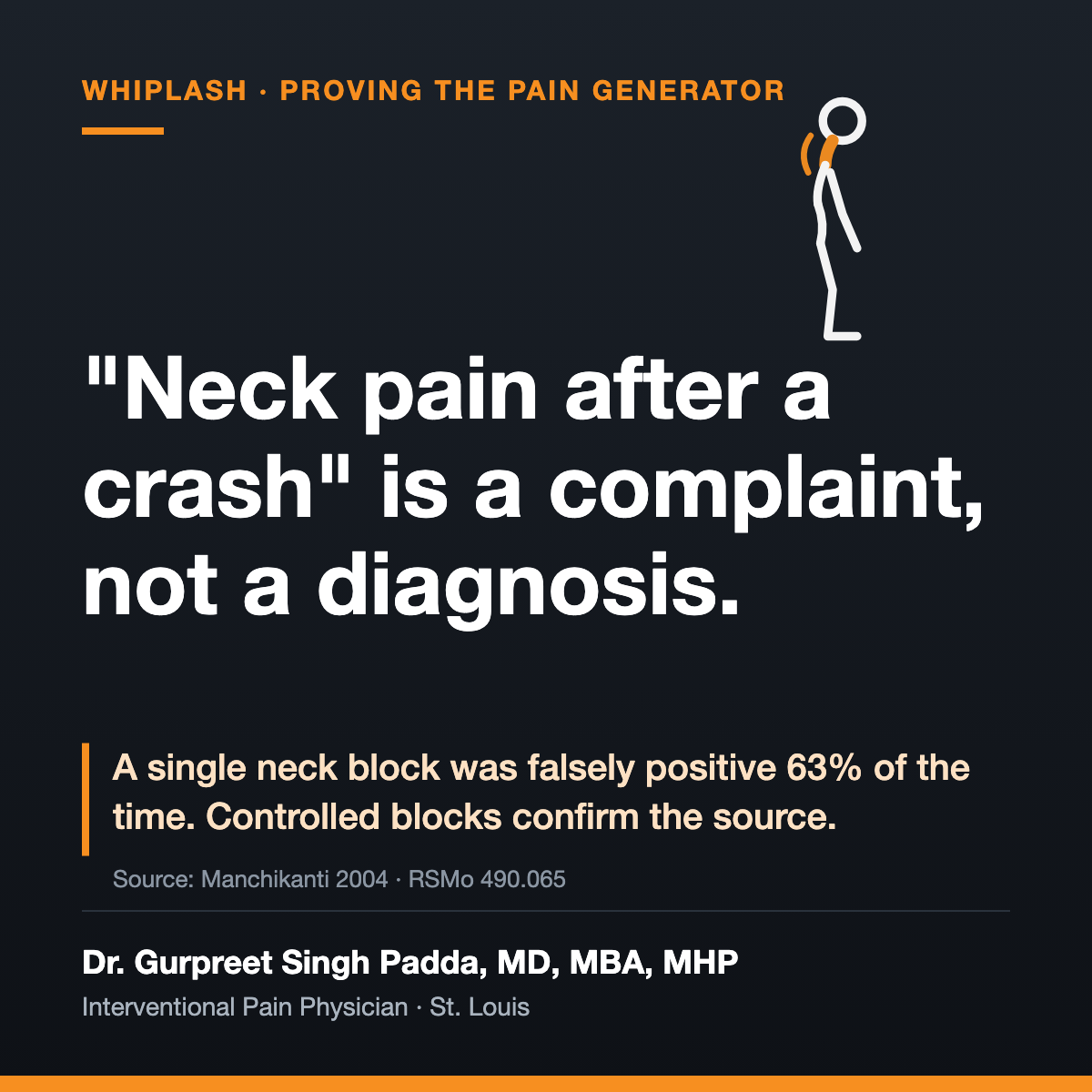
Researchers studied 500 patients with long-term spine pain at an American interventional pain practice. In those whose chronic pain was in the neck, testing with controlled blocks pinned the pain on the facet joints 55% of the time. That same paper found that a lone block in the neck gave a false positive in 63% of cases.
Read that second number slowly. If a single shot “worked,” the odds were worse than a coin toss that the joint was truly to blame. Relief alone is not evidence.
How does a physician confirm where the neck pain comes from?
Step by step, and with a stopwatch. Dr. Padda and our team start with a hands-on exam of the neck, shoulders and nerves. Imaging is compared against that exam. A scan alone often looks ordinary even when a facet joint is the problem.
If a facet joint is the suspect, the test is a controlled diagnostic block:
- Using live imaging, a short-acting numbing medicine is placed beside the nerves that supply the joint.
- Another day, the block is done again with a longer-acting medicine.
- After each visit you keep a pain diary, hour by hour.
- The joint is confirmed only if both blocks help, and the short one wears off sooner than the long one.
For a patient with a concussion, this has a second benefit. Once the neck is confirmed and treated, whatever headache or dizziness remains points more clearly at the brain. Each injury gets a fair look.
Is a chiropractor enough for whiplash with a concussion?
Chiropractic care can be part of getting better, and we respect the work chiropractors do. Movement matters after whiplash. What a chiropractic visit cannot do is examine the brain injury as a physician does, order and interpret the tests, or perform image-guided blocks. That is medical work, and with a head injury in the picture it should be done by a physician.
We are interventional pain physicians. Our job is to find which structure hurts, prove it, and then treat it. Recovery still depends on you, too: steady sleep, gradual return to activity and rebuilding neck strength. Our physiotherapy after a concussion program covers whiplash exercises and treatments for that stage.
Why does proof matter if you have an injury claim?
Patients come first, so the main reason is simple: treatment aimed at the confirmed source works on the right problem. A second reason matters to families and their lawyers. Since 2017, Missouri law (RSMo 490.065) has required that an expert’s opinion be based on enough facts, use reliable methods and apply them reliably to the case. An exam, controlled blocks, a timed pain diary and measured function give a record with that kind of footing. A vague note does not.
Some signs need an emergency department right away, not a clinic visit: a headache that keeps getting worse, repeated vomiting, confusion, new weakness or numbness, or trouble waking up.
Frequently asked questions
Can whiplash cause concussion symptoms?
A neck injury can cause headaches at the back of the head, unsteadiness and poor sleep, which overlap with concussion symptoms. That is why both the neck and the brain should be examined after a crash.
How do I know if my headache comes from my neck or my concussion?
Often you cannot tell on your own. A physician exam, concussion testing and, when needed, controlled diagnostic blocks of the neck sort out which injury is driving which symptom.
Will an MRI show whiplash damage?
An MRI can rule out serious damage, but an irritated facet joint often looks normal on it. Image-guided blocks done twice with two different numbing medicines are how the source is confirmed.
Where is the Concussion Center located?
Concussion Center is at 4477 Woodson Rd, Suite 105, St. Louis, MO 63134, near Lambert International Airport. Call (314) 887-5866 or schedule online.
Sources
- Manchikanti L, Boswell MV, Singh V, Pampati V, Damron KS, Beyer CD. Prevalence of facet joint pain in chronic spinal pain of cervical, thoracic, and lumbar regions. BMC Musculoskeletal Disorders. 2004;5:15. doi:10.1186/1471-2474-5-15
- Missouri Revised Statutes, section 490.065. Expert witness testimony (as amended 2017, HB 153). revisor.mo.gov