
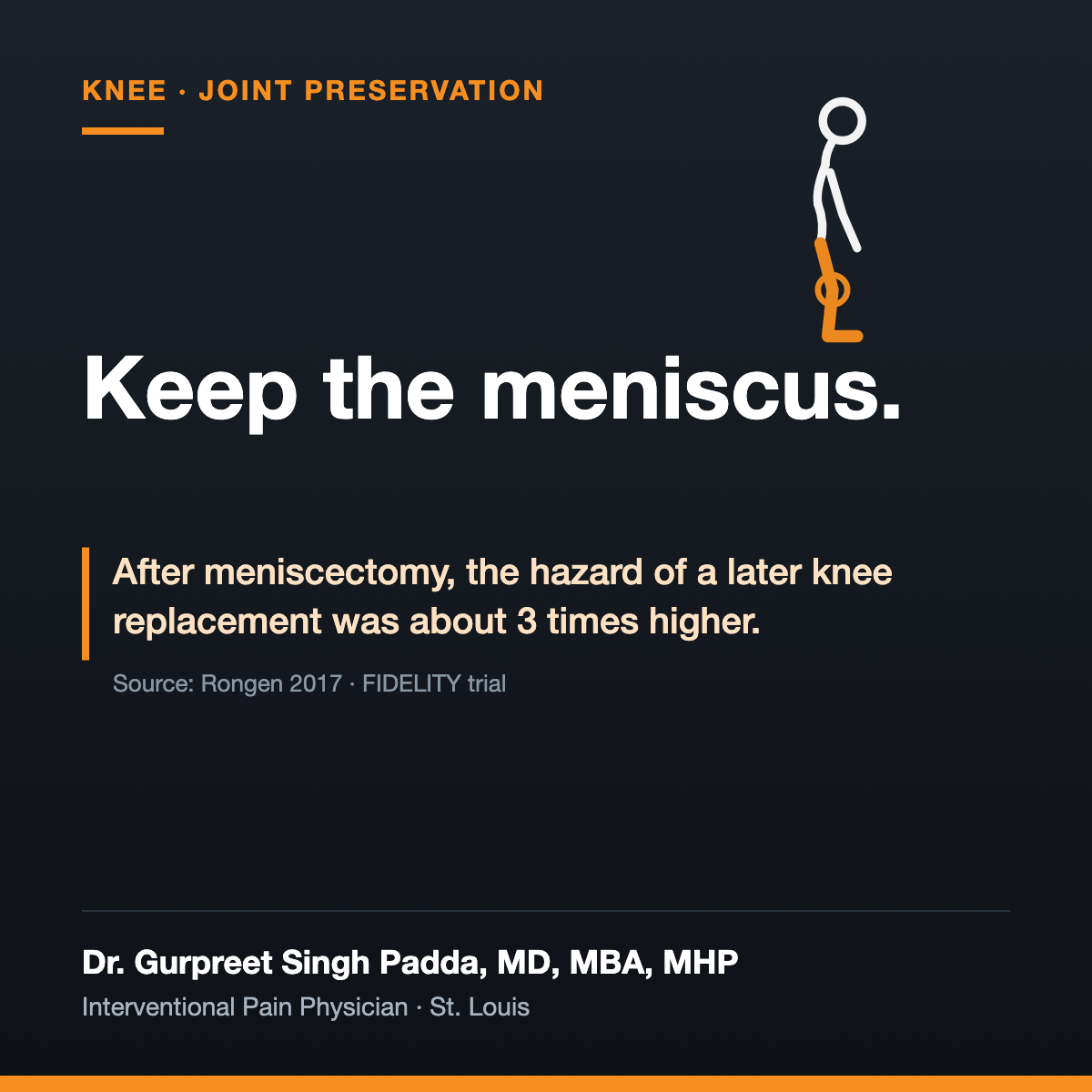
When a crash leaves you with both a concussion and a knee injury, the knee plan should protect the meniscus, the cartilage cushion inside the joint, instead of trimming it away. A common knee surgery that removes torn meniscus tissue has been linked to roughly triple the chance of a knee replacement later. Dr. Padda and our team treat the brain and the knee together, with a plan built to keep you moving and keep that cushion in place.
A head injury tends to take over the first weeks after an accident. Headaches, fog and poor sleep get the attention, and a sore knee gets pushed down the list. Then someone mentions an MRI and a quick scope, and it sounds like the simple fix. It often is not.
Why does a knee injury matter during concussion recovery?
Recovery from a concussion is not a matter of lying still for months. Our care builds activity back in planned steps, and a painful knee can stall that progress. A knee operation followed by a long, quiet stretch on the couch adds more inactivity to a body that is already trying to heal a brain.
We write often about the body’s metabolic state, sometimes called its terrain, and how it shapes brain recovery. Our post on why two people with the same concussion recover differently covers that link. Insulin resistance, extra pounds and inactivity work against the brain, and they work against knee cartilage too.
What does the meniscus do?
You have two in each knee. They are C-shaped pads of tough, rubbery tissue wedged between the femur (thigh bone) and the tibia (shin bone), and they share out the load every time you stand, walk or climb stairs. Take part of one away and that load lands on less cartilage, which then wears down sooner.
What happens to a knee after meniscus surgery?
A long US study called the Osteoarthritis Initiative compared 335 adults aged 45 to 79 who had an arthroscopic meniscectomy with 335 similar adults who did not. All had knee arthritis or were at risk for it. In the surgery group, 18.8% went on to a replacement of that same knee, compared with 11.1% of the matched group, a hazard about three times higher.1
The FIDELITY trial asked whether the operation even helps. Doctors in Finland randomly assigned 146 people aged 35 to 65 with a worn, degenerative tear to a real partial meniscectomy or a sham procedure in which nothing was removed. After 12 months, the two groups reported nearly identical gains.2 Five years later, the real-surgery group had:
- Slightly more arthritis changes on knee X-rays3
- More knees that caught or locked, an adjusted gap of 18 percentage points3
- Faster growth of bone spurs on MRI, at odds of 2.86 to 14
Those studies looked at worn knees, not fresh injuries from a collision. Still, many adults in a crash bring a knee with some wear already in it, and the lesson about keeping tissue applies to them.
How is the knee treated while the brain heals?
Our goal is to protect the tissue and keep you active enough to recover on both fronts:
- Knee injections. A review of 48 randomized trials covering 9,338 knees with arthritis found that platelet-rich plasma (PRP), hyaluronic acid and bone marrow aspirate concentrate (BMAC) each did better than steroid injections for pain and function at six months or more.5
- Strength and balance training. Our physiotherapy after a concussion program paces knee loading around concussion symptoms, so neither recovery holds the other back.
- Treating the terrain. Blood sugar, weight and daily movement get the same attention as the knee and the headache.
Will PRP grow back a torn meniscus?
It will not, and we say so plainly. A 2019 consensus from the European knee and sports surgery society found no evidence that PRP helps a torn meniscus heal.6 That group named meniscus preservation the first choice, since outcomes after partial removal trail those after repair over the long term.6 Its job here is easing pain and helping the knee work, with the meniscus left where it belongs.
When should a knee go to a surgeon?
A knee that is locked and cannot fully straighten, or a new tear that can be sewn back together, needs a surgeon. Repair saves the meniscus instead of removing it. Our exam tells these knees apart before anyone schedules an operation.
What should families and attorneys watch for?
If part of the meniscus is removed after a crash, plan for the knee replacement that may come years later, not just the scope itself. The record should show the knee exam, what was tried before surgery, and how the knee works over time. Our page on concussion in injury claims explains how we document both injuries.
Frequently asked questions
Can a concussion and a knee injury be treated at the same time?
Yes. We plan both together. Knee loading is paced around concussion symptoms so that activity can keep building for the brain and the joint.
Should I have surgery for a meniscus tear after a car accident?
Not always. For worn tears, a sham-controlled trial found partial removal worked no better than a fake operation. A locked knee or a tear that can be stitched is different and needs a surgeon.
Can PRP regrow my meniscus?
No. PRP does not rebuild meniscus tissue. It is used to ease knee pain and improve function while the meniscus is kept.
Where is the Concussion Center located?
Concussion Center is at 4477 Woodson Rd, Suite 105, St. Louis, MO 63134, near Lambert International Airport. Call (314) 887-5866 or schedule online.
Sources
- Rongen JJ, Rovers MM, van Tienen TG, Buma P, Hannink G. Increased risk for knee replacement surgery after arthroscopic surgery for degenerative meniscal tears: a multi-center longitudinal observational study using data from the osteoarthritis initiative. Osteoarthritis and Cartilage. 2017;25(1):23-29. doi:10.1016/j.joca.2016.09.013
- Sihvonen R, Paavola M, Malmivaara A, Itälä A, Joukainen A, Nurmi H, et al. Arthroscopic partial meniscectomy versus sham surgery for a degenerative meniscal tear. New England Journal of Medicine. 2013;369(26):2515-24. doi:10.1056/NEJMoa1305189
- Sihvonen R, Paavola M, Malmivaara A, Itälä A, Joukainen A, Kalske J, et al. Arthroscopic partial meniscectomy for a degenerative meniscus tear: a 5 year follow-up of the placebo-surgery controlled FIDELITY (Finnish Degenerative Meniscus Lesion Study) trial. British Journal of Sports Medicine. 2020;54(22):1332-1339. doi:10.1136/bjsports-2020-102813
- Sillanpää N, Iivanainen M, Turkiewicz A, Sihvonen R, Paavola M, Taimela S, et al. Effect of arthroscopic partial meniscectomy on structural degeneration of the knee – A 5-year MRI-based follow-up of the placebo-surgery controlled FIDELITY (Finnish Degenerative Meniscus Lesion Study) trial. Osteoarthritis and Cartilage. 2025;33(2):276-282. doi:10.1016/j.joca.2024.09.003
- Jawanda H, Khan ZA, Warrier AA, Acuña AJ, Allahabadi S, Kaplan DJ, et al. Platelet-Rich Plasma, Bone Marrow Aspirate Concentrate, and Hyaluronic Acid Injections Outperform Corticosteroids in Pain and Function Scores at a Minimum of 6 Months as Intra-Articular Injections for Knee Osteoarthritis: A Systematic Review and Network Meta-analysis. Arthroscopy. 2024;40(5):1623-1636.e1. doi:10.1016/j.arthro.2024.01.037
- Kopf S, Beaufils P, Hirschmann MT, Rotigliano N, Ollivier M, Pereira H, et al. Management of traumatic meniscus tears: the 2019 ESSKA meniscus consensus. Knee Surgery, Sports Traumatology, Arthroscopy. 2020;28(4):1177-1194. doi:10.1007/s00167-020-05847-3