
A crash that barely dents the car can still strain your neck and jolt your brain. When researchers looked at who still had neck pain a year after whiplash, the vehicle told them very little. The person’s own early symptoms told them much more. At the Concussion Center, Dr. Padda’s team records those early signs at the first visit and starts guided movement soon after the crash.
The same sudden motion that strains the neck also snaps the head back and forth. That is why neck pain and concussion symptoms so often show up together, and why a cheap repair estimate should never close the question of whether you were hurt.
Does a small dent mean a small injury?
No. A neck pain task force formed under the Bone and Joint Decade 2000-2010 sorted through 226 articles and accepted 47 sound studies on whiplash. Features of the collision, such as the side the car was struck from or the kind of headrest in the seat, did little to forecast recovery.1 A repair estimate measures the car. Your recovery depends on what happened to your body.
How many people still have neck pain a year after whiplash?
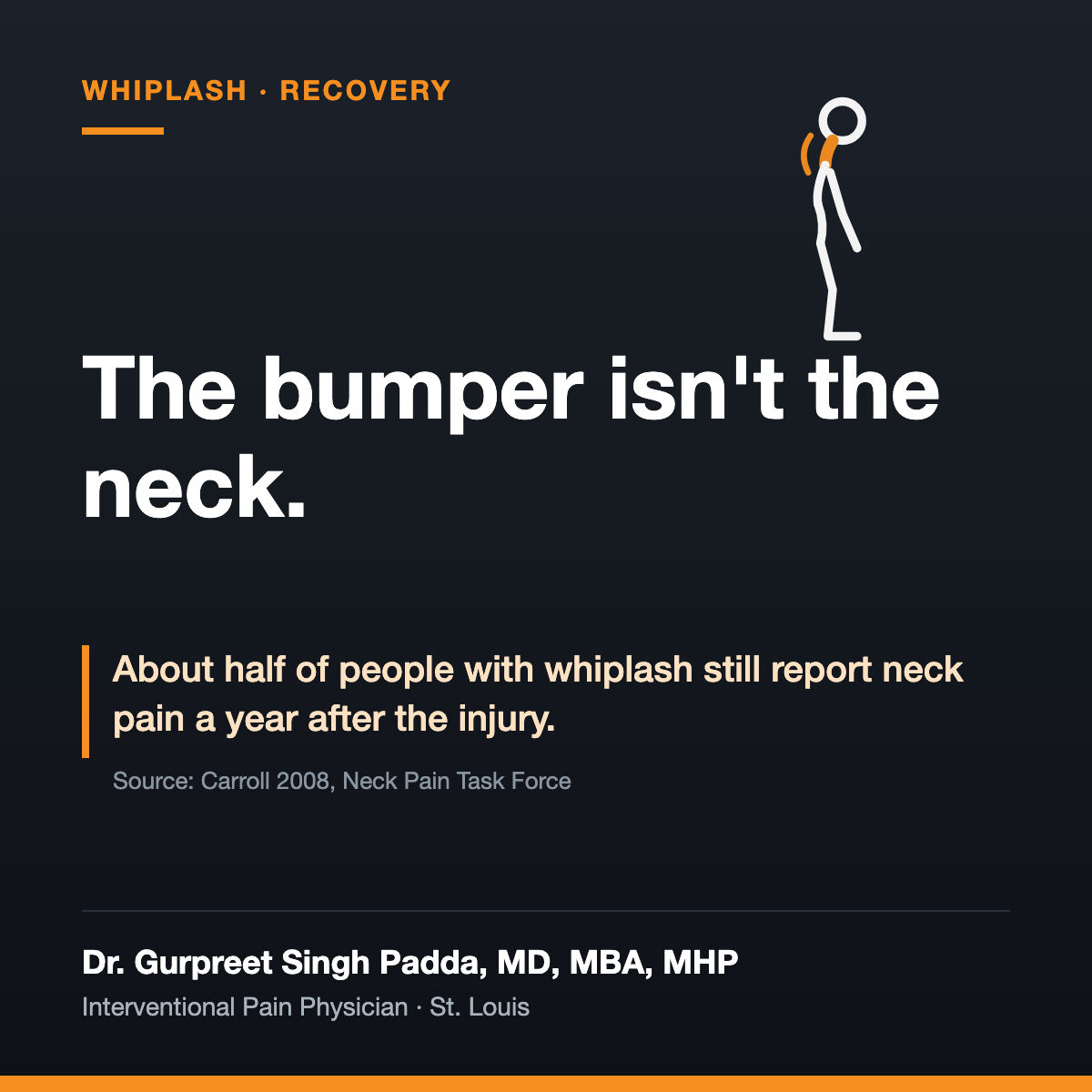
About half. That was the task force’s estimate: roughly 50% of people with whiplash report neck pain at the one-year mark.1 For someone who is also dealing with headaches, fogginess or broken sleep after a concussion, a neck that keeps hurting adds weight to an already heavy load.
Which early signs point to a slower recovery?
Three stood out in the evidence: high pain soon after the crash, a large number of symptoms, and real trouble with daily life in the first weeks.1 A concussion can push all three higher, because headache, dizziness and light sensitivity add to the count alongside the sore neck.
Reactions after the injury counted as well. People who were afraid to move, felt down, or coped passively by waiting things out tended to heal more slowly or less fully.1 Those are not character flaws. They are measurable parts of the injury, and they respond to care.
What happens to the neck in a rear-end crash?
The seat drives your torso forward while your head lags for an instant. In that moment the cervical spine forms an S-curve, with the lower neck bending back and the upper neck bending forward. The strain falls on the facet joints and on the small muscles that hold the head steady. It is over before anyone could brace, and the same jolt is what moves the head hard enough to cause a concussion.
Should I rest my neck after a crash?
Briefly, yes. For weeks, no. When turning your head hurts, you quit turning it, and the muscles that support the neck lose strength from lack of use. The neck stiffens, and the stiffness becomes a problem of its own. We bring motion back early and in measured steps, so inactivity does not turn into a second injury on top of the first.
How does the Concussion Center track the neck and the brain together?
At the first visit we record your pain and function, list every symptom, ask how you are sleeping, and watch how you move your head and neck. Those are the same markers the research links to recovery. Care then follows a written plan through our physiotherapy after concussion program, with home work such as the chin tuck for whiplash between visits.
What should families and attorneys take from this?
That a picture of a car is not a medical record. The facts that shape how a neck injury unfolds are clinical ones: early pain and disability, the whole symptom list, sleep, and movement. We write those down from day one, as numbers where we can. Our page on concussion in injury claims explains how we document the brain injury side of the same crash.
Frequently asked questions
Can a minor crash cause whiplash and a concussion?
Yes. How much the car was damaged is a poor guide to how much you were hurt. Get checked if your neck aches or you notice headaches, dizziness or trouble thinking after a crash.
How long does whiplash take to heal?
It varies from person to person. The review estimated that roughly one in two whiplash patients was still sore at the one-year point. Early, measured care aims to keep you out of that group.
Is it safe to move my neck after whiplash?
With guidance, yes. We examine the neck first, then rebuild movement step by step so the supporting muscles do not weaken from disuse.
Where is the Concussion Center located?
Concussion Center is at 4477 Woodson Rd, Suite 105, St. Louis, MO 63134, near Lambert International Airport. Call (314) 887-5866 or schedule online.
Neck pain or headaches since the crash?
We examine the neck and the brain together, record the signs that shape recovery, and start guided movement early.
Schedule an evaluation or call (314) 887-5866.
Sources
- Carroll LJ, Holm LW, Hogg-Johnson S, Côté P, Cassidy JD, Haldeman S, et al. Course and prognostic factors for neck pain in whiplash-associated disorders (WAD): results of the Bone and Joint Decade 2000-2010 Task Force on Neck Pain and Its Associated Disorders. Spine. 2008;33(4 Suppl):S83-92. doi:10.1097/BRS.0b013e3181643eb8