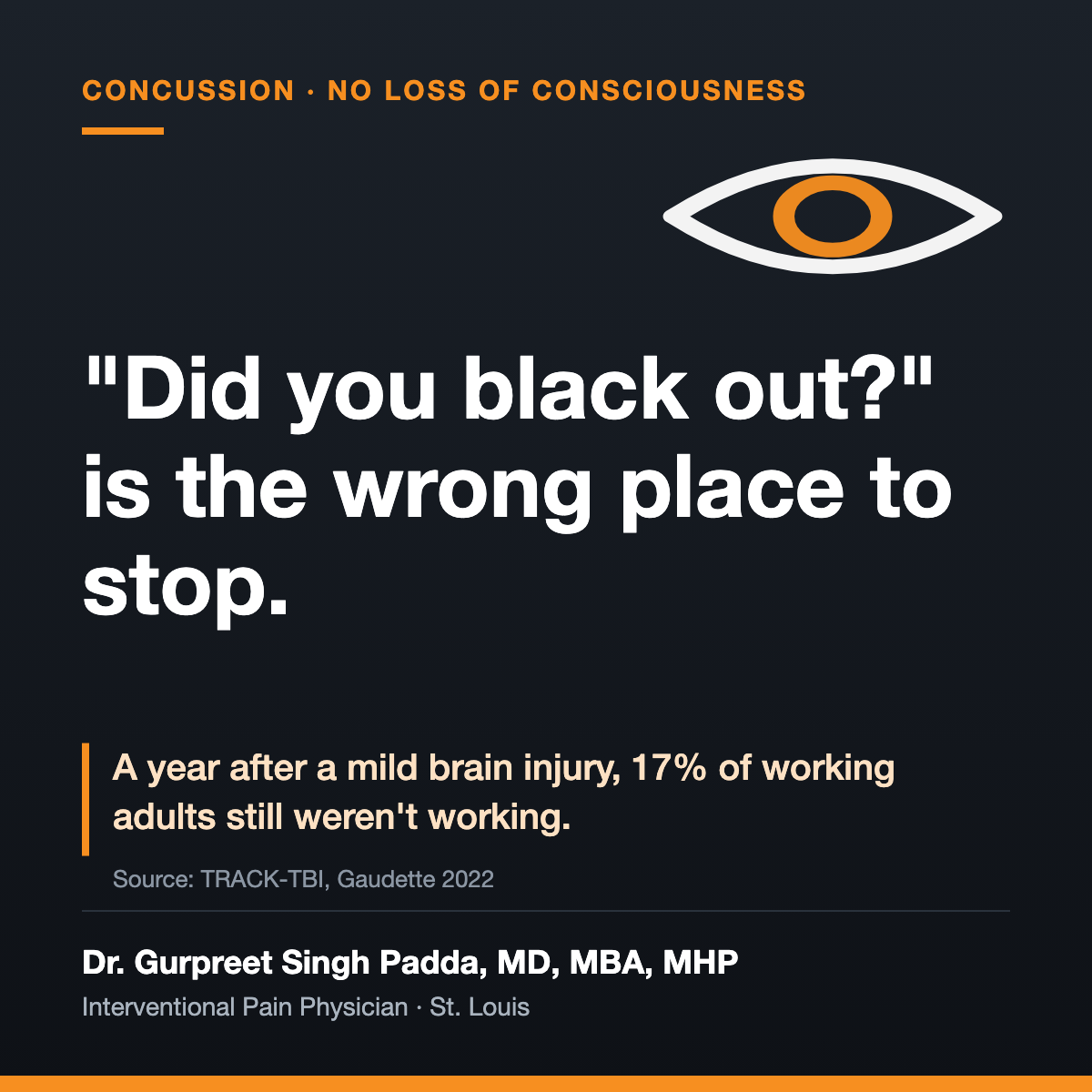
Most people can return to work after a concussion from a crash, but many need weeks, and some need far longer. Whether you blacked out tells us little about which group you are in. The symptoms you still have, especially at the three-month mark, tell us much more. Dr. Padda and our team track those symptoms on a schedule and help plan a gradual, early return to the job.
Families often feel relieved when they hear their loved one never lost consciousness. That relief can come too soon. The person may look fine at the dinner table and still struggle to get through a shift.
Dr. Padda was trained the same way. During his medical training, losing consciousness was treated as the mark of a real concussion. The science of how brain cells react to a jolt has since moved well past that idea.
Does a concussion count if you never lost consciousness?
It does. Our page on concussion without loss of consciousness covers this in depth. In short, a hard jolt throws off the balance of salts inside and outside brain cells, and a surge of glutamate follows. The cells then run short of energy just when they need the most of it. That energy gap is the injury, and it shows up whether or not the lights went out.1 You can read more about it on our page explaining what a concussion does to the brain.
Which early signs point to a slower recovery?
Researchers tracked 1,507 college athletes after a concussion to see who still had symptoms at four weeks or beyond. Losing consciousness did not raise the odds. Five other things did:2
- Being unable to recall what happened right before the hit
- Struggling to focus or keep a train of thought
- Finding bright light painful or hard to bear
- Insomnia, meaning poor or broken sleep
- Having had a concussion before
If any of these sound familiar after a crash, say so at your visit, even if they seem small. They help us judge how long recovery may take and what to treat first.
How many people are off work after a mild brain injury?
More than most expect. A large US study called TRACK-TBI enrolled 435 adults between 18 and 64 who had a job before their injury. All were seen at one of 11 major trauma centers for a mild brain injury, the same label that covers most concussions.3
- Two weeks after the injury, 59% had not gone back to work.
- A full year later, 17% still had not.
- Over one in five earned less in a year than before the injury.
For a family, those numbers mean missed paychecks, a changed routine, and sometimes a career that bends in a new direction.
Why does the three-month check matter so much?
Because it sorts people. In TRACK-TBI, those reporting three or more concussion symptoms three months out were less likely to be on the job a year after the crash: 73% were working, compared with 89% of those reporting two or fewer.3
That is why we do not ask about symptoms one time and close the chart. We count them at follow-up visits and again around three months, then aim treatment at whatever is still holding you back. Our concussion diagnosis and testing page lists the balance, eye movement and memory tests we use.
What helps you get back on the job?
Three things stand out, and all of them start early:
- Steady follow-up. Symptoms are counted on a schedule so changes are caught.
- Better sleep. Insomnia is one of the warning signs, so we treat it directly instead of waiting for it to pass.
- Changes at work in the first three months. In TRACK-TBI, employees offered help such as sick leave, shorter hours, a modified schedule or other tasks were working more often at one year, 86% versus 72%.3
Our physiotherapy after a concussion program adds graded activity, balance work and testing so your tolerance for a full day can build back step by step.
What if the ER chart barely mentions your head?
That happens often. Emergency care focuses on dangers that need action in the next few hours. A study from one Minnesota county reviewed 1,678 brain injury events and found no Glasgow Coma Scale score for 74% of them. Nearly half, 49%, never got a CT of the head.4
A blank space in the chart does not mean the injury was small. It means it still needs to be measured and written down. Families and attorneys can learn how that record gets built on our page about concussion in injury claims.
Some signs need an emergency department right away, not a clinic visit: a headache that keeps getting worse, repeated vomiting, confusion, new weakness or numbness, or trouble waking up.
Frequently asked questions
How long after a concussion can I go back to work?
It varies. In one large study, most adults with a mild brain injury were working by one year, but more than half were still off work at two weeks. A gradual return, planned with your physician, works better than an all-or-nothing date.
Is it a real concussion if I did not lose consciousness?
Yes. Most concussions happen without passing out. The brain injury comes from a chemical and energy disruption inside brain cells, which happens with or without a blackout.
What should I ask my employer for after a concussion?
Ask about options like sick leave, shorter hours, a changed schedule or different tasks for a while. In one study, workers offered that kind of help early were more likely to be working a year later.
Where is the Concussion Center located?
Concussion Center is at 4477 Woodson Rd, Suite 105, St. Louis, MO 63134, near Lambert International Airport. Call (314) 887-5866 or schedule online.
Sources
- Giza CC, Hovda DA. The new neurometabolic cascade of concussion. Neurosurgery. 2014;75 Suppl 4:S24-S33. doi:10.1227/NEU.0000000000000505
- Zuckerman SL, Yengo-Kahn AM, Buckley TA, Solomon GS, Sills AK, Kerr ZY. Predictors of postconcussion syndrome in collegiate student-athletes. Neurosurgical Focus. 2016;40(4):E13. doi:10.3171/2016.1.FOCUS15593
- Gaudette É, Seabury SA, Temkin N, Barber J, DiGiorgio AM, Markowitz AJ, Manley GT. Employment and economic outcomes of participants with mild traumatic brain injury in the TRACK-TBI study. JAMA Network Open. 2022;5(6):e2219444. doi:10.1001/jamanetworkopen.2022.19444
- Malec JF, Brown AW, Leibson CL, Flaada JT, Mandrekar JN, Diehl NN, Perkins PK. The Mayo classification system for traumatic brain injury severity. Journal of Neurotrauma. 2007;24(9):1417-1424. doi:10.1089/neu.2006.0245