
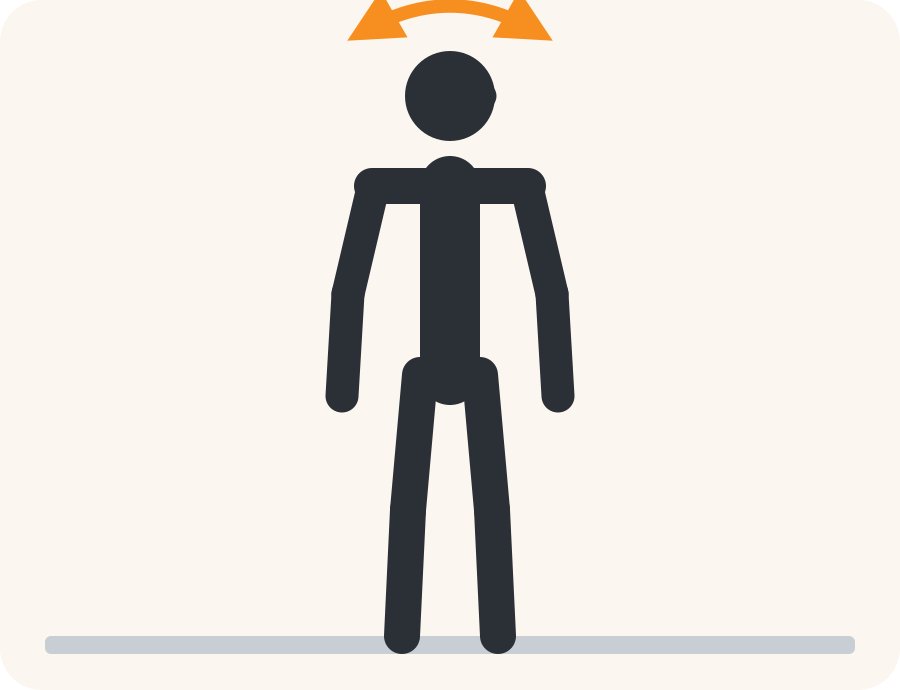
The neck turn keeps your neck from locking up while the whiplash part of a concussion heals. Sitting tall, slowly turn your head toward one shoulder, hold 3 seconds, then turn the other way, 10 times each side.
Only the exercises circled on your home program are yours to do. If this one is circled, do it two times daily unless the sheet says otherwise.
Steps for the neck turn
- Start: Sit tall on a sturdy chair, shoulders soft.
- Move: Turn your head slowly to look toward one shoulder, only as far as feels comfortable. Return to center and repeat toward the opposite side.
- Repeat: Pause 3 seconds at each end; 10 times per side.
How the neck turn helps a whiplash neck
A stiff neck that will not turn makes daily life harder: backing out of a driveway, checking a blind spot, or looking at someone who is talking to you. Gentle turning keeps the joints and muscles moving while they heal, so the neck does not settle into a short, guarded range.
After a concussion, turning the head can sometimes bring on dizziness, because the neck, the eyes and the inner ear all report head position to the brain. If that happens, stop and tell us. It is useful information, and it may be a reason your physician orders a VNG dizziness test.
How do you pace it after a concussion?
Start with fewer repetitions if your symptoms are easily stirred up, and build toward the full number over several days. Mild stretch or soreness is fine. A headache that builds, dizziness, or blurry vision is a sign to stop for the day and tell us at your next visit.
What mistakes should you avoid?
- Jerky, fast turns or bouncing at the end.
- Your shoulders rotating with your head.
- Going into sharp pain. Stop where you first feel strain.
When is it time to stop and phone us?
Call us at (314) 887-5866, and stop for the day, if you notice:
- Sharp or stabbing pain
- Numbness, tingling or weakness in an arm or hand that is new
- Pain 2 points above your usual that has not eased after an hour
- Dizziness or any change in your vision
Go to the emergency room or call 911 if, after a head injury, you have a headache that keeps getting worse, vomit more than once, have a seizure, slur your words, feel new weakness or numbness, or become more confused or hard to wake. Do not wait for a physiotherapy visit.
Bring your log to every visit
Mark your log after every session, and jot down one pain and symptom score per day. The technician checks your count of days at every visit and asks you to show one exercise.
What to remember
- Slow turns, and stop at the first strain.
- Shoulders stay still; only the head turns.
- Dizziness while turning is something to report, not push through.
Show us you have it: At your next visit, turn to each side once while your technician watches your shoulders. Questions are welcome; we are glad to go over it twice.
The rest of your whiplash neck exercises
- Chin Tuck Exercise for Whiplash
- Side Bend Neck Stretch for Whiplash
- Shoulder Blade Squeeze for Whiplash
This page belongs to our physiotherapy after a concussion program. Our physicians examine you, sign each order and watch over the care, and treatment waits whenever no physician is in the building to step in. Our technicians are trained and checked on every machine; they are not physical therapists.