
The chin tuck retrains the small stabilizers buried deep in the front of the neck, which often go quiet after the whiplash that comes with most concussions. Sit tall and glide your head straight back until your chin draws in; do 10 of them, holding each for 5 seconds.
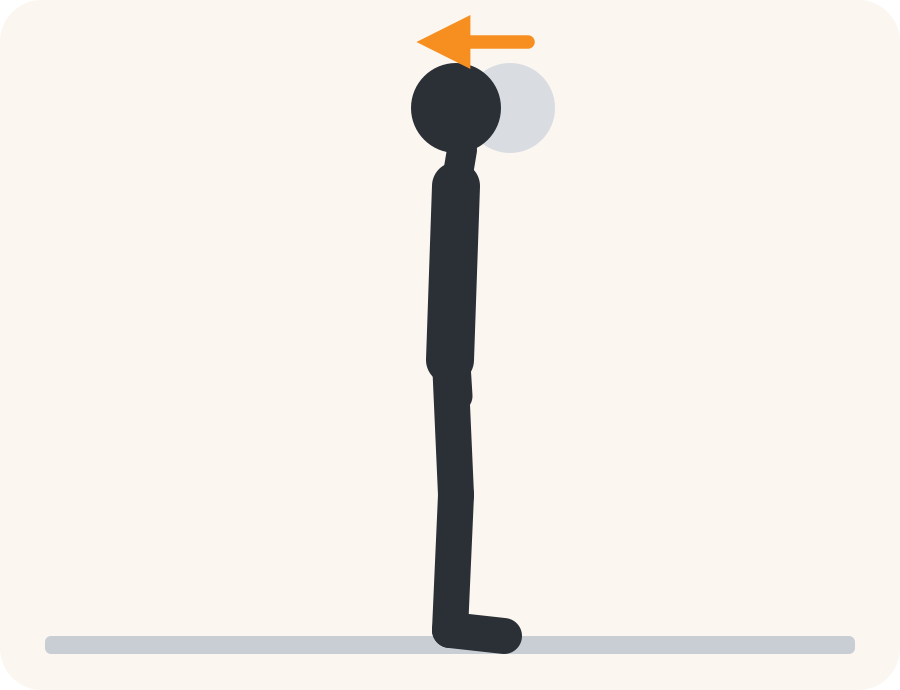
Only the exercises circled on your home program are yours to do. If this one is circled, do it two times daily unless the sheet says otherwise.
Steps for the chin tuck
- Start: Sit or stand up straight with your eyes looking at a spot straight ahead.
- Move: Glide your head straight backward so your chin draws in toward your throat. Picture tucking into a double chin, keeping your gaze on that spot.
- Repeat: Keep it there 5 seconds, then let go. Ten in all.
How the chin tuck helps a whiplash neck
The same jolt that shakes the brain whips the neck. Afterward, the thin muscles that sit deep in the front of the neck tend to shut off. The larger muscles on the surface then clench to hold your head up, and that clenching is a common source of neck ache and stiffness. The chin tuck wakes the deep muscles back up and teaches your head to rest over your shoulders instead of drifting forward.
Some headaches after a crash start in the upper neck rather than in the brain. Our page on occipital neuralgia vs concussion explains how we tell the two apart.
How do you pace it after a concussion?
Start with fewer repetitions if your symptoms are easily stirred up, and build toward the full number over several days. Mild stretch or soreness is fine. A headache that builds, dizziness, or blurry vision is a sign to stop for the day and tell us at your next visit.
What mistakes should you avoid?
- Nodding your head down. Your eyes should not drop toward the floor.
- Forcing it. This is a small glide, not a hard push.
- Shoulders creeping upward.
When is it time to stop and phone us?
Call us at (314) 887-5866, and stop for the day, if you notice:
- Sharp or stabbing pain
- Numbness, tingling or weakness in an arm or hand that is new
- Pain 2 points above your usual that has not eased after an hour
- Dizziness or any change in your vision
Go to the emergency room or call 911 if, after a head injury, you have a headache that keeps getting worse, vomit more than once, have a seizure, slur your words, feel new weakness or numbness, or become more confused or hard to wake. Do not wait for a physiotherapy visit.
Bring your log to every visit
Mark your log after every session, and jot down one pain and symptom score per day. The technician checks your count of days at every visit and asks you to show one exercise.
What to remember
- Chin slides back; head does not tip down.
- Small and gentle is the right size.
- Stop if it makes you dizzy or your vision changes.
Show us you have it: At your next visit, do three chin tucks in front of your technician, with your eyes level the whole time. Questions are welcome; we are glad to go over it twice.
The rest of your whiplash neck exercises
- Neck Turn Exercise for Whiplash
- Side Bend Neck Stretch for Whiplash
- Shoulder Blade Squeeze for Whiplash
This page belongs to our physiotherapy after a concussion program. Our physicians examine you, sign each order and watch over the care, and treatment waits whenever no physician is in the building to step in. Our technicians are trained and checked on every machine; they are not physical therapists.